
How to Complete Form T776 template for Rental Property Income in Canada – 2026 Step-by-Step Guide

Updated: Feb 25
You can simply download our tax return T776 template from our free template bank or receive it automatically after submitting the online tax return form. Chinese and English are supported.
If you earn rental income from property in Canada, you must report it on Form T776 – Statement of Real Estate Rentals. At Kewang Professional, we’ve created a clear Excel template to simplify this process. Whether you rent out a condo, house, basement suite, or Airbnb, this guide will walk you through filling out your T776 accurately.
Who needs to File Form T776 template?
You must complete Form T776 if you:
Own rental property (residential or commercial)
Receive rental income, even if it’s from a single room or short-term rental (Airbnb)
Share ownership of a rental property (report your percentage of income/expenses)
Before You Start – Gather Your Documents
Property address and ownership details
Rental income records (bank deposits, lease agreements)
All expense receipts (mortgage interest, property taxes, repairs, etc.)
If applicable: HST/GST number, Airbnb income reports, property manager statements
Step-by-Step Guide to Completing the Kewang T776 Template
Our template is divided into clear sections. Here’s how to fill each one:
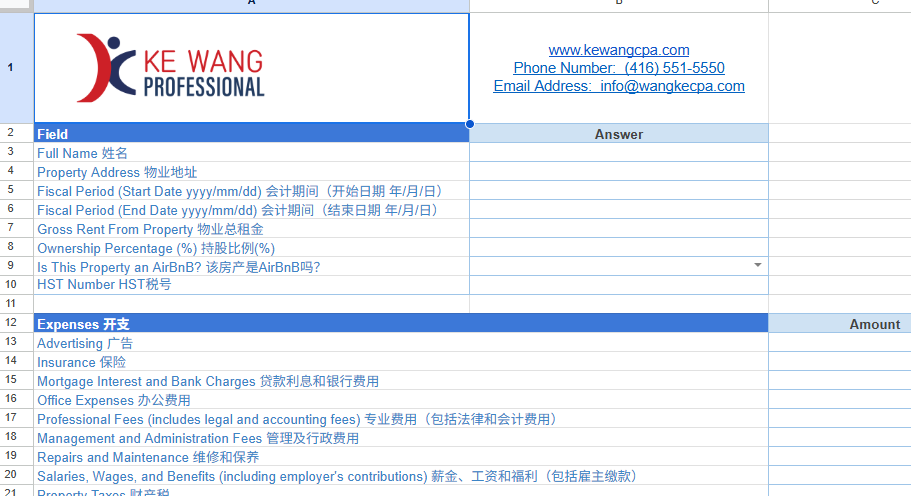
Section 1: Property & Owner Information
Full Name: Enter the property owner’s legal name.
Property Address: Full address of the rental property.
Fiscal Period: Enter the start and end dates for the rental period (usually January 1 – December 31 for personal taxes).
Gross Rent From Property: Total rent collected before expenses.
Ownership Percentage: Your share if co-owning (e.g., 50%).
Is This Property an AirBnB? Select Yes/No. Airbnb income is still rental income but may have different expense rules.
HST Number: If you’re HST-registered for your rental business (often required for short-term rentals).
Section 2: Rental Expenses
Only expenses incurred to earn rental income are deductible. Enter amounts for:
Advertising: Costs to advertise the rental.
Insurance: Property insurance premiums.
Mortgage Interest and Bank Charges: Interest portion of mortgage payments (not principal), plus bank fees.
Office Expenses: Small costs for supplies, postage, etc.
Professional Fees: Legal or accounting fees related to the rental.
Management and Administration Fees: If you use a property manager.
Repairs and Maintenance: Fixes that maintain the property (e.g., painting, plumbing). Not renovations that add value.
Salaries, Wages, and Benefits: If you pay someone for rental-related work.
Property Taxes: Municipal property tax bills.
Travel Expenses: Driving to and from the rental for inspections/repairs (keep a log).
Utilities: If you pay for utilities (heat, water, electricity, internet).
Section 3: Totals & Net Income
Total Deductible Expenses: Auto-calculated if you use formulas; otherwise, sum all expenses.
Net Rental Income: Gross Rent minus Total Expenses. This amount goes on your personal tax return.
Withholding Tax Paid: Only if non-resident withholding tax was deducted from your rental income.
🔁 Short-Term (Airbnb) vs. Long-Term Rental
Airbnb: Usually considered business income. You may need to charge/collect HST if revenue > $30,000/year.
Long-Term Rental: Generally passive income. HST does not apply to residential long-term rents.
💡Airbnb: Usually considered business income. You may need to charge/collect HST if revenue > $30,000/year.
💡Long-Term Rental: Generally passive income. HST does not apply to residential long-term rents.

T2125 Tax Return Template Q&A:
Frequently Asked Questions (T776)
Q1: Can I claim mortgage principal payments?
A: No. Only mortgage interest is deductible. Principal repayment is not an expense.
Q2: What if I rent out part of my home?
A: You can only claim expenses for the rented portion (based on area and time used).
Q3: Are capital improvements (like a new roof) deductible?
A: No. These are capital expenses added to the property’s cost base. You may claim depreciation (CCA) but this can affect future taxes.
Q4: Do I need receipts for all expenses?
A: Yes. Keep receipts and documents for at least 6 years in case of CRA review.
Q5: What if my rental runs at a loss?
A: You can report a loss, which may reduce your overall taxable income.
Q6: How do I handle co-ownership?
A: Each owner reports their percentage of income and expenses.
Q7: Is Airbnb income treated differently?
A: It’s still rental income but may be subject to HST and different expense allocations (e.g., cleaning fees, supplies).


Comments